
Philadelphia County Busted Booking Records
Philadelphia runs its city and county government as one structure. Still, no single office holds every record. The Philadelphia Police Department, or PPD, produces arrest and identification files. The Philadelphia Department of Prisons, or PDP, runs the local jails. Court paperwork belongs to the First Judicial District. The Sheriff handles courthouse security and warrants but does not operate the jails. Know which office holds what before you ask for anything.
An arrest, the booking, a transfer to a PDP facility, and a first court appearance can land on different days. So don't treat them as one event with one date. PPD policy puts arrest photographs to use in identification and investigative work. That policy does not turn the PDP locator into a photo gallery. The locator shows where someone is in custody. Its instructions promise no photo, no charges, no bond, and no booking sheet you can download.
A booking entry marks the administrative processing of an arrest event and the start of an agency's paper trail.
Busted Philadelphia Booking Record Fields
The public PDP instructions offer exactly two ways to search. Use a full name plus date of birth, or a Philadelphia inmate ID called a PID. More detail might sit in a custodian's file or the court record. But nothing more is promised in a public result. Always match beyond a name. A name-only hit can attach the wrong person to the wrong case.
| Field | What to verify |
|---|---|
| PID or inmate ID | The PDP locator accepts a PID and it is more precise than a name search. |
| Arrest and booking times | They can differ because police custody and jail intake are separate events. |
| Charges as booked | These are charges and can change as the prosecution and court process continue. |
| Facility and release status | A person may move among PDP, state, federal, or immigration custody. |
| MC-51 or CP docket | The UJS docket is the route for arraignment, later court events, and disposition. |
| Photo status | Ask whether a photograph exists and is disclosable. Do not assume a public locator displays it. |
These words get mixed up, so here is the plain version. Booking is the intake paperwork after an arrest. Bond or bail is a release condition set by a court. An arraignment is an early court appearance, and a disposition is the final court result. Each term names a different stage of the process.
Dates matter too. An arrest time can precede intake by hours. A facility can change after classification, and the court docket often lags the initial paperwork. An unofficial entry may blur those events or skip the docket entirely. The strongest match pairs an exact name with a PID or other lawful identifier, then checks the agency record or docket. A photo alone proves nothing about identity.
- PID
- Philadelphia's inmate identifier used in the PDP custody search.
- OTN
- A Pennsylvania Offense Tracking Number that can help connect agency and court records.
- ARD
- Accelerated Rehabilitative Disposition, a Pennsylvania diversion outcome that is not a conviction finding.
Philadelphia County Records Requests
When the locator fails you, Pennsylvania's Right-to-Know Law gives a formal path. Philadelphia's Open Records policy demands a written request signed with your real name, a clear description of an existing record, and delivery to the correct Open Records Officer. Expect an answer within five business days. A permitted extension can stretch that to 30 calendar days. Any withholding must cite its legal basis.
For an arrest record or a PPD-held photograph, use the PPD Right-to-Know route. That officer sits at the Philadelphia Public Services Building, 400 North Broad Street, Suite 72, Philadelphia, PA 19130-4015. The published email is Police.RightToKnow@phila.gov, and the fax is (215) 686-1183. For a PDP record, follow the City Open Records policy. Name PDP as the likely custodian, and ask the city to point to the real custodian if it holds nothing responsive.
- Use the Pennsylvania standard RTKL form and give a name and contact method.
- Name the person, PID or docket if known, arresting agency, and a narrow date range.
- Ask for inspection or a copy of the existing booking record or photograph, if maintained and disclosable.
- Ask for non-exempt portions and the cited reason for any denial or redaction.
PPD has no duty to build a new database or stitch together a mass list from scattered systems. A police incident report travels its own route through the Department of Records. That public-safety office sits at City Hall Room 170, 1400 John F. Kennedy Boulevard, with questions answered at (215) 686-2266. Its report estimates are not a promised timeline for a booking photograph.
Be precise about what you want. A police incident report, a booking record, a controlled identification image, a media-release image, and a court paper are different documents. Drawing that line helps the custodian route your request and explain any denial or redaction. If another office holds the record, ask for the proper custodian instead of repeating a broad request. Appeals also branch differently when criminal-investigative material is involved, so keep the agency's written response and the case or request number handy.
Note: A Sheriff-held warrant or courthouse record should go to the Sheriff's own Open Records Officer, not straight to PDP.
Philadelphia Busted Mugshot Law
Pennsylvania's Right-to-Know Law, 65 P.S. §§ 67.101 et seq., starts from the premise that local-agency records are public. It still allows exemptions for investigative, privacy, and public-safety material. The Criminal History Record Information Act separates public chronological entries, like certain blotters and wanted posters, from other criminal-justice information. Office of Open Records decisions show a booking photograph released in one case and withheld in another. So a request lives or dies on its custodian and record facts, not on a claim that every mugshot must go out the door.
No Pennsylvania statute bans commercial booking-photo publication or charges fees for removal right now. House Bill 1585 passed the House and sat in the Senate Judiciary Committee. It remained a proposal, not law. Don't describe it as current law. Juvenile, sealed, expunged, medical, victim-identifying, and protected investigative records can stay off limits even when similar records are public.
Correction path: Fix the underlying court or agency record first. Everything else flows from that. If a website still shows an incorrect or restricted copy, use its published free correction process and supply the official paperwork. Watch out for anyone demanding money to fix a record, and keep in mind that a private takedown is not the same thing as legal expungement.
Philadelphia Busted Custody Lookup
Philadelphia has no single official page posting every recent arrest alongside a booking photograph. For a current local custody question, start with the city's PDP Locate an Incarcerated Person service. It connects to the live locator. It covers only PDP-managed facilities. A search needs a full name plus date of birth, or a PID number. If the service goes down, three PDP help lines are listed: (215) 685-8394, (215) 685-8395, and (215) 685-8396.
- Check PDP first when the question is whether a person is currently held in Philadelphia custody.
- Check the selective PPD News-Blotter only for an official public-safety post, not as a complete intake list.
- Search UJS Case Search for the Philadelphia court record and its later events.
- Submit a focused records request when an existing document or photo is not publicly displayed.
- Move to the state, federal, or ICE locator only when the person's custody state has changed.
The official PDP locator is the right entry point for this current-custody search.
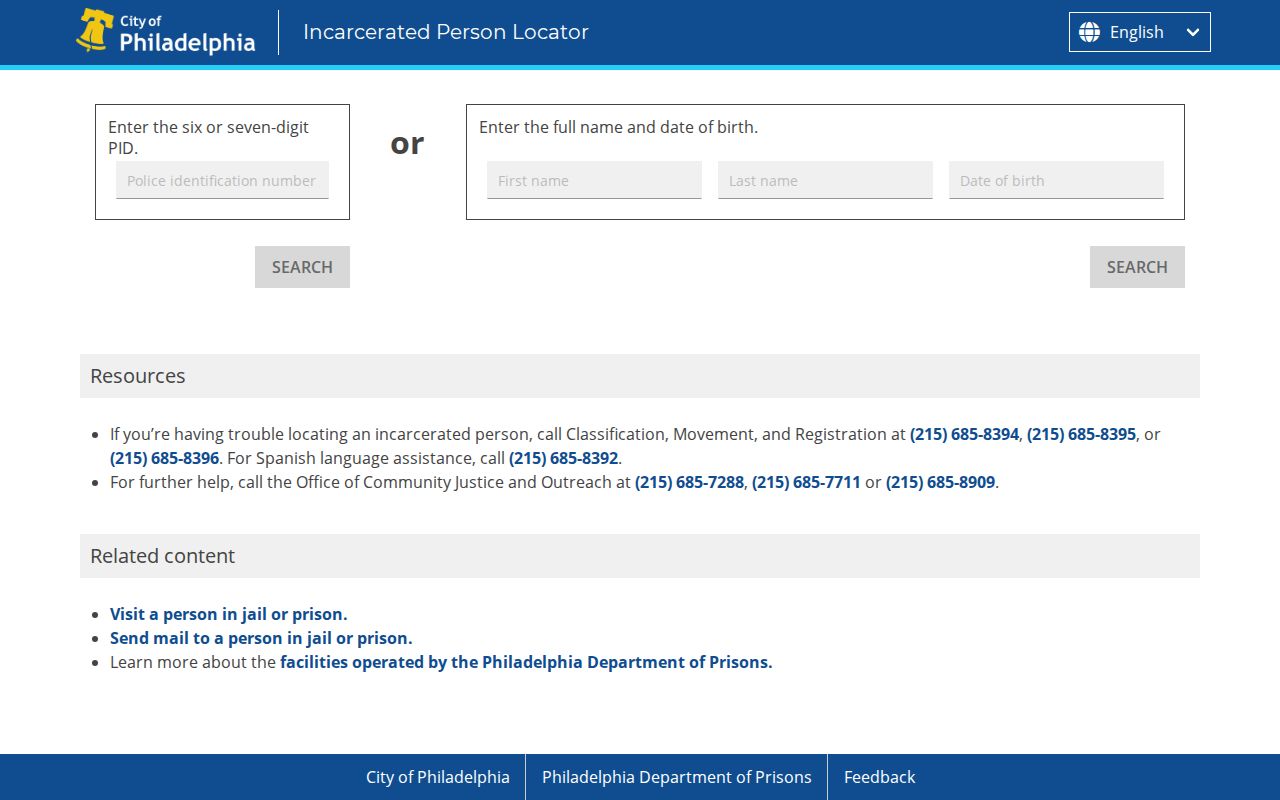
The locator's published scope is current PDP custody and nothing more. A blank result or a temporary outage tells you little on its own, and a later court record or a direct answer from a records custodian will carry more weight for a focused request.
Why Philadelphia Has No Booking Feed
PDP's Daily Headcount and Census refreshes daily. It counts heads, though, not names. Population totals are all you get. No names, booking numbers, same-day arrests, or photographs appear there. The department's broader population snapshots serve historical context instead. Neither product is a person-level booking feed covering 24 hours, 48 hours, 72 hours, or a week.
PPD's News-Blotter is selective too. Posts may cover wanted notices, missing persons, surveillance material, arrest announcements, or public-information releases. A story that names its source and date can still help. What it cannot do is show who passed through PDP processing on any given day. Weekend volume, feed windows, and posting lifespans go undocumented. Philadelphia simply publishes no public booking list of that kind.
Note: An absence from the locator answers a custody question only, not whether an arrest happened or a person went free.
Busted Philadelphia Roster Search
Think of the PDP locator as a current-custody search, not an open jail roster. The official instructions spell out identity inputs and facility scope. Even so, they promise no charges, bond amounts, booking dates, court dates, release dates, or photographs. Alternate versions of the locator address sometimes show a system-down message. Use the official city service page instead. Its phone fallback makes it the dependable route.
| Search input | Use and limit |
|---|---|
| Full name and date of birth | The city says both are required for a name search. Use the exact legal spelling when possible. |
| PID | Search by the Philadelphia inmate ID if it is already known. Confirm present status separately. |
| Daily census | Shows facility-level totals only. It cannot locate a named person or document a booking. |
Four PDP facilities operate in the city. These are Curran-Fromhold Correctional Facility, The Detention Center, Philadelphia Industrial Correctional Center, and Riverside Correctional Facility. A current locator result shows where someone sits today, not a permanent assignment. People move between buildings as transfers and intake changes happen. An old news article or an unofficial repost is weak evidence of anyone's current facility.
Philadelphia Booking Photo Controls
Two PPD directives shape how arrest photographs circulate. Directive 5.10 covers them in an identification and investigative setting. Directive 4.16 sets up a controlled Public Affairs route for releasing a suspect photo to media with approval. Together they explain why an agency photo can exist yet never surface on the PDP locator. Neither policy creates a publication schedule, and no public PDP result displays a booking photo.
Official sources should always come first. Among commercial archives, Mugshots.com's Philadelphia County section is the one county-specific option. It reads as historical material, though, not a current-booking window. It is not a government roster. Entries can linger online after a court outcome changes, so treat nothing there as proof of identity or current custody. If a listing is stale or wrong, use the host's free correction process once official paperwork is in hand.
Busted Arrests Across Custody Systems
Where an arrest happened rarely tells you who holds the person now. Label each search by custody state. That keeps a local pretrial question distinct from a state sentence, a federal sentence, or immigration detention. Keep one more thing in mind. None of the official systems listed below works as a public gallery of booking photos.
| Custody state | Official place to check | What it answers |
|---|---|---|
| Current local PDP custody | PDP locator | Whether a person is in a PDP-managed facility. |
| State sentence or parole | PA DOC locator | State-sentenced or parolee status, not local pretrial detention. |
| Federal custody | BOP locator | Federal inmate location, not a Philadelphia booking record. |
| ICE custody | ICE detainee locator | Current ICE or qualifying recent CBP custody. |
A transfer settles nothing about the case itself. Follow the current court docket to see what happens next. Federal and immigration locator results belong in their own files, never blended into a Philadelphia jail record.
Philadelphia Court Disposition Path
A criminal arrest in Philadelphia starts in Municipal Court. That court handles misdemeanors and felony preliminary hearings. Felonies then move up to the Court of Common Pleas. The statewide UJS search is flexible, letting you look up a case by participant name, docket number, OTN, complaint or incident number, arresting agency, county, case status, or docket type. MC-51 and CP records can link together, so watch for later docket events instead of assuming the first case closes the matter.
Arraignment, plea, dismissal, nolle prosequi, acquittal, and sentence are all court events. A booking record cannot settle any of them. Neither can news coverage or a photograph. For a live court trail, rely on First Judicial District and UJS sources rather than an old arrest post.
Case status matters: Charges entered at booking may later be reduced, dismissed, withdrawn, or resolved some other way, so check the current docket for the outcome.
Philadelphia Booking Alerts and Releases
Don't expect a Sheriff-run mugshot app here. Philadelphia's real custody tools are the PDP web portal and its phone line, and neither works like a photo gallery on your phone. Want notice when someone is released, transferred, or escapes? Pennsylvania SAVIN, also reachable through VINELink, handles that. Register once and it sends updates by text, email, app, phone, or web. It tracks custody status, not pictures.
ReadyPhiladelphia plays a different role entirely. It pushes citywide emergency and public-safety notices, including the READYPHILA text option, but it will never alert you about one person's arrest. Match the tool to the question. Custody alerts answer release questions; ReadyPhiladelphia covers the wider safety picture.
Philadelphia Expungement and Corrections
Expungement happens in court, not through a private website's delete button. Pennsylvania's own process starts with PSP Form SP 4-170, a $20 certified check or money order, and proper identification. In Philadelphia, the Rule 790 petition asks for details like the MC or CP docket number, the OTN, the arresting agency, the charges, and the disposition. Eligibility turns on the specifics of each record. A qualified attorney or the court's own materials are the right place for that advice.
Once a court grants an expungement, sealing, correction, or wrong-identity finding, hold onto the paperwork. Present it to the agency first, then to the host through its published free process. Google's outdated-content route comes last, and only after the source record itself has changed or vanished. One thing it cannot do: clearing a search result never touches the original record, and an unofficial takedown is not an expungement.
Philadelphia Busted Record Archives
Philadelphia posts no fixed retention window for PDP booking records or photographs. The public locator focuses on current custody. Its instructions say nothing about how long a released person's entry stays up. PDP population snapshots and the daily census keep aggregate counts rather than name-level booking history. So start with the likeliest custodian. PDP holds detention records, PPD keeps arrest and identification files, and the First Judicial District has dockets and court papers.
Pennsylvania's local-government retention schedules help you ask whether a series of court papers was kept, transferred, or destroyed on schedule. They promise nothing about jail-management photos from the same era. The County Records Manual sets different retention periods for criminal papers depending on how a case ended, while a booking image may sit with another custodian under a different series or exemption. Name the court, the docket year, the arresting agency, the facility, and the exact record type. A blanket request for all mugshots will get you nowhere.
For old news coverage, the Free Library's Newspapers and Microfilm Center is the place to look. A clipping is not a certified booking record, though, and it may skip what happened later. Pair it with a court docket when you can. If an agency says records moved, ask for the series name, retention status, and depository reference before approaching an archive.
Note: An old booking photo can outlive the case it came from, so record the source and access date and verify current case status with the court.
Philadelphia Arrest Data Is Not Bookings
Aggregate numbers add context, but they won't name a recent booking. Philadelphia's open-data crime-incidents resource carries preliminary incident data stretching back to 2006. Pennsylvania's Uniform Crime Reporting portal publishes arrest distributions and trends reported by agencies. Neither is a jail roster. Neither is a booking-photo index or a headcount of everyone processed at PDP on a given day.
That gap matters when someone spots a spike in the data and goes hunting for a name. Incidents, arrests, bookings, court filings, and custody status are separate records. A dashboard cannot tell you whether a person was held, released, transferred, or cleared. It also cannot stand in for the agency's report or the court's final disposition. Treat aggregate data as background, then take the specific question back to the official locator, the docket, or the records process.
Philadelphia Busted Mugshots by City
Philadelphia County contains exactly one incorporated municipality on the official city map. That consolidation means city police, PDP custody, and the Philadelphia courts overlap heavily without ever merging into one office. The Philadelphia Busted Mugshots page maps the PPD-to-PDP booking path and local publication limits at the city level. For notable public stories and tips on tying them to official records, browse Crime News & Mugshots.
Get Philadelphia County Booking Records In Person
Choose the office by the record needed. The Sheriff's Office
7901 State RoadPhiladelphia, PA 19136
(215) 685-8394